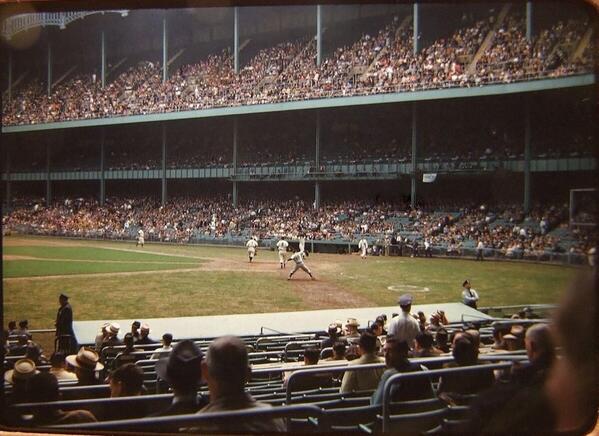
EDIT: I like how all the people in the upper deck are spaced to avoid the poles being in their sightlines.

They would sell the seats behind the poles, in the event of a sellout, but I imagine they sold them as "obstructed view" or something like that. There's an old Warners cartoon ("Porky's Baseball Broadcast") that features an old gent who spends the whole game trying to find his seat and it turns out to be behind the pole - and he sits down just as Porky describes the exciting finish to the game at which point the guy starts tearing down the stadium. Classic Bob Clampett stuff.pioneer98 wrote:Yankee Stadium in 1947. What is the deal with all the railings inbetween every 2 or 3 rows of seats?
EDIT: I like how all the people in the upper deck are spaced to avoid the poles being in their sightlines.
They sold the box seats as blocks of about six or so. You bought the whole "box" of seats, and they were segregated with a railing around the group. Most of the box sales were probably to companies that used them for employees or customers that they wanted to impress. I worked for a St. Louis company for 15 years, and when I was in town for a sales meeting, I could use one of the tickets. As a box holder, you could also invite players to your meetings for lunch and a little Q and A on a personal basis. We had Stan at a couple meetings, as well as Red, and Joe Medwick.pioneer98 wrote:Yankee Stadium in 1947. What is the deal with all the railings inbetween every 2 or 3 rows of seats?
EDIT: I like how all the people in the upper deck are spaced to avoid the poles being in their sightlines.
Not sure but I remember those railings at Shea as well:pioneer98 wrote:Yankee Stadium in 1947. What is the deal with all the railings inbetween every 2 or 3 rows of seats?
EDIT: I like how all the people in the upper deck are spaced to avoid the poles being in their sightlines.
Makes sense. Thanks for clearing that up.Knot Hole Gang Vet wrote:They sold the box seats as blocks of about six or so. You bought the whole "box" of seats, and they were segregated with a railing around the group. Most of the box sales were probably to companies that used them for employees or customers that they wanted to impress. I worked for a St. Louis company for 15 years, and when I was in town for a sales meeting, I could use one of the tickets. As a box holder, you could also invite players to your meetings for lunch and a little Q and A on a personal basis. We had Stan at a couple meetings, as well as Red, and Joe Medwick.pioneer98 wrote:Yankee Stadium in 1947. What is the deal with all the railings inbetween every 2 or 3 rows of seats?
EDIT: I like how all the people in the upper deck are spaced to avoid the poles being in their sightlines.


If you could sum up the stupidity of powder blue uniforms with just one photo, this would do the trick.Freed Roger wrote:

Weird how that got so popular. I don't even think of that as a popular color back then.JL21 wrote:If you could sum up the stupidity of powder blue uniforms with just one photo, this would do the trick.Freed Roger wrote:


