In Dr Strangelove they said the doomsday machine would make earth radioactive for ten thousand years.Socnorb11 wrote:What are the exposure rates in the forbidden zone?
Radiation wouldn't absorb into topsoil and trees, would it? And rivers and ocean?
Fukushima disaster much worse then we are told
-
slide_into_first

- is unaware that dangerous is the real Tyler Durden
- Posts: 14433
- Joined: June 10 09, 11:31 pm
- Location: In Chula Vista hanging with the Surenos
Re: Fukushima disaster much worse then we are told
-
pioneer98

- Hall Of Famer
- Posts: 22007
- Joined: July 15 08, 8:24 pm
- Location: High A Minors
Re: Fukushima disaster much worse then we are told
OK so I don't know much about it, but millisieverts and microsieverts are the units they use to measure radiation. He visited a monitoring station where they track the levels inside the forbidden zone. Many were reading between 3 and 5 microsieverts/hour, and the worst one was 13 microsieverts/hour. It said that 1 millisievert or less over 1 year is what is considered "safe". It also said some of the workers got 100 millisieverts (not good). The one city he was in near the forbidden zone back in March 2011 he was getting 23 microsieverts/hour, which is 600X what he measured Tokyo. But today that same city is way down from that. He claims he measured 2.5 microsieverts/hour when he was in an airplane over the US.Socnorb11 wrote:What are the exposure rates in the forbidden zone?
Radiation wouldn't absorb into topsoil and trees, would it? And rivers and ocean?
These are not levels that will give you radiation sickness, but these kind of levels might cause cancer or other problems. We don't really know. We also don't know if getting 1 millisievert over a year is the same risk as getting 1 in 1 day.
The "voluntary" forbidden zone originally was a 40 km radius. Then it was reduced to 20 km. Then they totally changed the shape of it after they figured out the path that the fallout went:
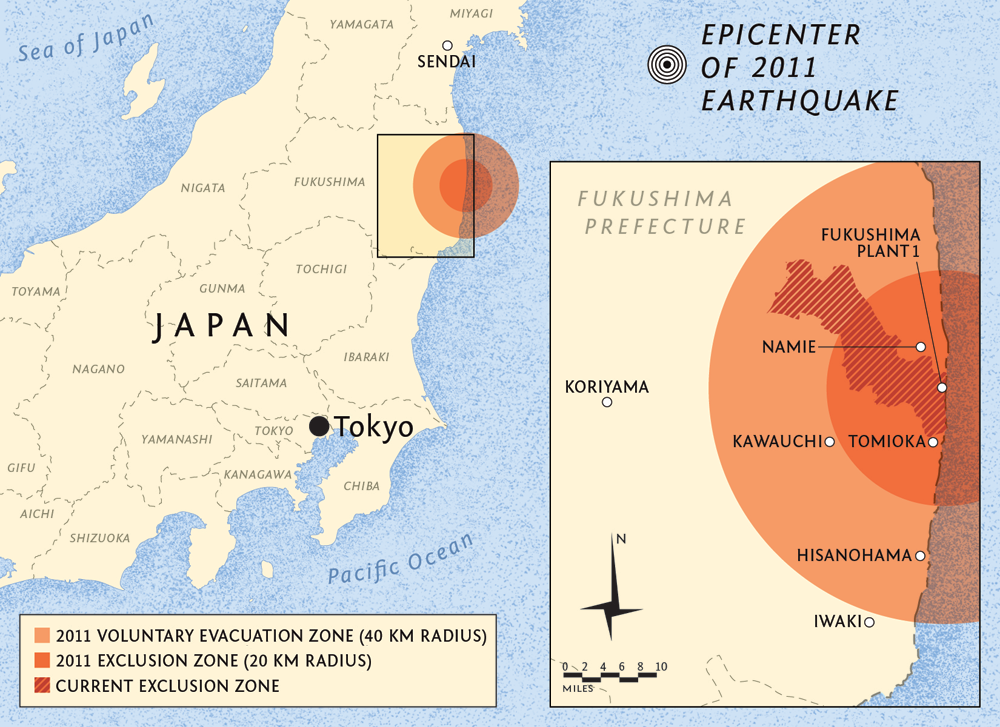
-
pioneer98
- Hall Of Famer
- Posts: 22007
- Joined: July 15 08, 8:24 pm
- Location: High A Minors
Re: Fukushima disaster much worse then we are told
Iwaki was the city he was in much of the time, where he measured 23 microsieverts/hour back in 2011. Then he went back last year and only measured 0.04 microsieverts/hour. Dilution I guess?
-
Vidor
- You've just been hit by...VidorSmarm™
- Posts: 22956
- Joined: June 10 10, 7:50 pm
Re: Fukushima disaster much worse then we are told
I wonder how much these radiation dangers compare with, say, taking a chest x-ray or getting a sunburn.
-
pioneer98
- Hall Of Famer
- Posts: 22007
- Joined: July 15 08, 8:24 pm
- Location: High A Minors
Re: Fukushima disaster much worse then we are told
It said that 1 chest x-ray was roughly equivalent to 1 microsievert. So obviously 1 millisievert would be 1,000 chest x-rays.Vidor wrote:I wonder how much these radiation dangers compare with, say, taking a chest x-ray or getting a sunburn.
So yeah, 23 microsieverts/hour would be like 23 x-rays per hour.
Last edited by pioneer98 on March 2 15, 2:17 pm, edited 1 time in total.
-
Swirls

- gone fission
- Posts: 8299
- Joined: December 11 07, 4:15 pm
- Location: South Korea
Re: Fukushima disaster much worse then we are told
You have to be careful with those terms, because they're metric rather than SI. In the US we use rem as the standard base of radiation dose: 1 sievert = 1 gray = 100 rempioneer98 wrote:OK so I don't know much about it, but millisieverts and microsieverts are the units they use to measure radiation. He visited a monitoring station where they track the levels inside the forbidden zone. Many were reading between 3 and 5 microsieverts/hour, and the worst one was 13 microsieverts/hour. It said that 1 millisievert or less over 1 year is what is considered "safe". It also said some of the workers got 100 millisieverts (not good). The one city he was in near the forbidden zone back in March 2011 he was getting 23 microsieverts/hour, which is 600X what he measured Tokyo. But today that same city is way down from that. He claims he measured 2.5 microsieverts/hour when he was in an airplane over the US.Socnorb11 wrote:What are the exposure rates in the forbidden zone?
Radiation wouldn't absorb into topsoil and trees, would it? And rivers and ocean?
These are not levels that will give you radiation sickness, but these kind of levels might cause cancer or other problems. We don't really know. We also don't know if getting 1 millisievert over a year is the same risk as getting 1 in 1 day.
The "voluntary" forbidden zone originally was a 40 km radius. Then it was reduced to 20 km. Then they totally changed the shape of it after they figured out the path that the fallout went:
The average annual dose per person in the US is around 600 millirem (6 millisieverts or 6000 microsieverts). The NRC allows up to I think 1 rem whole body for non-nuclear workers, and up to 5 rem whole body for nuclear workers. I'm positive on the whole body, as it is regulated by 10CFR20. I didn't see anything in it on a quick perusal for non-nuclear workers. It also establishes limits of 50 rem for organs, 15 rem for eyes, and 50 rem to extremities/shallow dose (skin only).

Living near a nuclear plant you will receive, on average, <1 millirem annually of radiation exposure. Rad gets 50x that just living in Denver because it is so high above sea level.
-
Socnorb11
- The Last Word
- Posts: 21913
- Joined: June 21 06, 8:45 am
Re: Fukushima disaster much worse then we are told
5 microsieverts/hr isn't dangerous on any level, really. To be honest, 13 microsieverts/hr isn't really an unacceptable level either. In the United States, for example, anything under 20 microsieverts/hr doesn't even have to be roped off from the public or contained, per NRC regulations. 5000 microsieverts in a year for a member of the general public is considered non-relevant. For occupational purposes, the limit allowed for an individual is 50,000 microsieverts per year.
Inside of the homes in Japan, I would assume the levels will be significantly less than they are in the unshielded space outside. That being said, I wouldn't want to have a home in those areas, necessarily.
Unless their regulations are WAY more strict than the ones in the United States, saying that more than 1 millisievert in a year is unsafe is inaccurate. In the United States, anything under 5 millisieverts over a years' time is considered non-relevant even for the general public, and workers can receive up to 50 millisieverts over a year's time. For NRC definitions, "non-relevant" is defined as the dose of radiation that in the light of present knowledge, is not expected to cause appreciable bodily injury to a person at any time during the lifetime.
The average person in the United States receives about 3600 microsieverts (3.6 millisieverts) every year from natural sources of radiation, such as radon.
Last edited by Socnorb11 on March 2 15, 2:57 pm, edited 3 times in total.
-
pioneer98
- Hall Of Famer
- Posts: 22007
- Joined: July 15 08, 8:24 pm
- Location: High A Minors
Re: Fukushima disaster much worse then we are told
Swirls wrote:You have to be careful with those terms, because they're metric rather than SI. In the US we use rem as the standard base of radiation dose: 1 sievert = 1 gray = 100 rempioneer98 wrote:OK so I don't know much about it, but millisieverts and microsieverts are the units they use to measure radiation. He visited a monitoring station where they track the levels inside the forbidden zone. Many were reading between 3 and 5 microsieverts/hour, and the worst one was 13 microsieverts/hour. It said that 1 millisievert or less over 1 year is what is considered "safe". It also said some of the workers got 100 millisieverts (not good). The one city he was in near the forbidden zone back in March 2011 he was getting 23 microsieverts/hour, which is 600X what he measured Tokyo. But today that same city is way down from that. He claims he measured 2.5 microsieverts/hour when he was in an airplane over the US.Socnorb11 wrote:What are the exposure rates in the forbidden zone?
Radiation wouldn't absorb into topsoil and trees, would it? And rivers and ocean?
These are not levels that will give you radiation sickness, but these kind of levels might cause cancer or other problems. We don't really know. We also don't know if getting 1 millisievert over a year is the same risk as getting 1 in 1 day.
The "voluntary" forbidden zone originally was a 40 km radius. Then it was reduced to 20 km. Then they totally changed the shape of it after they figured out the path that the fallout went:
The average annual dose per person in the US is around 600 millirem (6 millisieverts or 6000 microsieverts). The NRC allows up to I think 1 rem whole body for non-nuclear workers, and up to 5 rem whole body for nuclear workers. I'm positive on the whole body, as it is regulated by 10CFR20. I didn't see anything in it on a quick perusal for non-nuclear workers. It also establishes limits of 50 rem for organs, 15 rem for eyes, and 50 rem to extremities/shallow dose (skin only).
Living near a nuclear plant you will receive, on average, <1 millirem annually of radiation exposure. Rad gets 50x that just living in Denver because it is so high above sea level.
Hmmmm.....This is a quote from the article. Is there anything wrong with what he's saying here?
Many poor souls had toiled for TEPCO in the hideous environs of No. 1, and some had been exposed to a dose of more than a hundred millisieverts of radiation. A maximum of one millisievert per year for ordinary citizens is the general standard prescribed by the International Commission on Radiological Protection. According to The First Responder’s Guide to Radiation Incidents, first responders should content themselves with fifty millisieverts per incident, for although radiation sickness manifests itself at twenty times that dose, cancer might well show up after lower exposures.
-
Swirls
- gone fission
- Posts: 8299
- Joined: December 11 07, 4:15 pm
- Location: South Korea
Re: Fukushima disaster much worse then we are told
Yeah, one millisievert per year is nothing. Like Broncos said above, unless the rest of the world is just super ultra mega-conservative compared to the US, that limit is bonkers. US NRC legally allows up to 50 millisieverts per year, and up to 10x that annually for doses to extremities or organs.
-
Socnorb11
- The Last Word
- Posts: 21913
- Joined: June 21 06, 8:45 am
Re: Fukushima disaster much worse then we are told
I'm with you, Swirls - this conversation would be much simpler if we could talk in terms of Rems & Millirems. I had to do the conversions in order to make sense of any of it.