His "Smoke and Mirrors" and "Riding the Wheel of Fortune" are already classics.heyzeus wrote:DAMMIT i've just wasted 5 minutes trying to find a Miguel Batista poem to post here, but his stupid [expletive] website is down.
Poetry
-
sighyoung

- Mayor of GRB
- Posts: 38613
- Joined: April 17 06, 7:42 pm
- Location: Louisville
Re: Poetry
-
Smith Corks One
- All-Star
- Posts: 1426
- Joined: April 27 10, 11:08 pm
Re: Poetry
Wordsworth is one of my favorite poets, and I love "Lines Composed a Few Miles Above Tintern Abbey". Here's an excerpt from a paper I wrote about it (partly) for a college course, if you're interested.
The process of maturing from youth to adult, and the characteristics of people in these two stages of development, are common themes explored throughout literature. While all humans who live to physical adulthood undergo some manner of maturation, these events are never identical from person to person and often vary significantly. Two very eloquent autobiographical works – the poem “Lines Composed a Few Miles above Tintern Abbey,” by William Wordsworth, and Frederick Douglass’ Narrative of the Life of Frederick Douglass – provide examples of personal maturation that, while similar in some ways, differ markedly in terms of timing, form, and circumstance.
In “Tintern Abbey,” Wordsworth describes returning to the same place that he had visited five years before. While many of his initial observations of the setting bring back vivid memories of the natural wonders he previously beheld, it soon becomes apparent that he has matured greatly in the years since his last visit. Wordsworth uses the word “again” four times in the first fourteen lines of the poem, indicating that, on the surface, his current experience mimics the previous one. Once again he “hears,” “beholds,” “reposes,” and “sees,” and for someone interested purely in the sensory perception and enjoyment of the natural world, these endeavors might be enough. For Wordsworth, however, these sensations in and of themselves fall short of the rapture that, as a more mature man, he desires – or, perhaps, requires.
Then again, maybe “requires” isn’t exactly the right word either, as the superior sense of wellness and transcendent joy that permeates his soul seems to be a direct result of his natural maturing, and as such, a state that he now carries with him always. As he writes regarding his sister, in whom he sees the excitement of his former self, “these wild ecstasies shall be matured into a sober pleasure… thy mind shall be a mansion for all lovely forms” (lines 138-40). While we often use the word “sober” as a synonym for “somber,” in the first line quoted above, Wordsworth seems to be indicating that the source of his pleasure is no longer outside influences. The following line suggests that all such pleasures can be achieved within one’s own mind.
Another word that Wordsworth uses more than once in “Tintern Abbey” is “sublime”; he describes in lines 95-102 “a sense sublime/Of something far more deeply interfused” that “rolls through all things.” While his earlier sojourns with nature are described as “course” and related as animalistic adventures, his soul now communes with the very essence that permeates the universe. This transformation seems not to have occurred through any great effort on Wordsworth’s part, but more as a natural result of the maturation process – though, perhaps, not a ubiquitous human experience, but one reserved for those sensitive and attuned enough to be considered great poets.
The process of maturing from youth to adult, and the characteristics of people in these two stages of development, are common themes explored throughout literature. While all humans who live to physical adulthood undergo some manner of maturation, these events are never identical from person to person and often vary significantly. Two very eloquent autobiographical works – the poem “Lines Composed a Few Miles above Tintern Abbey,” by William Wordsworth, and Frederick Douglass’ Narrative of the Life of Frederick Douglass – provide examples of personal maturation that, while similar in some ways, differ markedly in terms of timing, form, and circumstance.
In “Tintern Abbey,” Wordsworth describes returning to the same place that he had visited five years before. While many of his initial observations of the setting bring back vivid memories of the natural wonders he previously beheld, it soon becomes apparent that he has matured greatly in the years since his last visit. Wordsworth uses the word “again” four times in the first fourteen lines of the poem, indicating that, on the surface, his current experience mimics the previous one. Once again he “hears,” “beholds,” “reposes,” and “sees,” and for someone interested purely in the sensory perception and enjoyment of the natural world, these endeavors might be enough. For Wordsworth, however, these sensations in and of themselves fall short of the rapture that, as a more mature man, he desires – or, perhaps, requires.
Then again, maybe “requires” isn’t exactly the right word either, as the superior sense of wellness and transcendent joy that permeates his soul seems to be a direct result of his natural maturing, and as such, a state that he now carries with him always. As he writes regarding his sister, in whom he sees the excitement of his former self, “these wild ecstasies shall be matured into a sober pleasure… thy mind shall be a mansion for all lovely forms” (lines 138-40). While we often use the word “sober” as a synonym for “somber,” in the first line quoted above, Wordsworth seems to be indicating that the source of his pleasure is no longer outside influences. The following line suggests that all such pleasures can be achieved within one’s own mind.
Another word that Wordsworth uses more than once in “Tintern Abbey” is “sublime”; he describes in lines 95-102 “a sense sublime/Of something far more deeply interfused” that “rolls through all things.” While his earlier sojourns with nature are described as “course” and related as animalistic adventures, his soul now communes with the very essence that permeates the universe. This transformation seems not to have occurred through any great effort on Wordsworth’s part, but more as a natural result of the maturation process – though, perhaps, not a ubiquitous human experience, but one reserved for those sensitive and attuned enough to be considered great poets.
-
Radio63
- Everyday Player
- Posts: 211
- Joined: July 25 06, 3:27 pm
- Location: Chickasaw Nation
Re: Poetry
Did you know there's a quarterly literary magazine that publishes lots of poems (and stories and other stuff) all of it about baseball? Elysian Fields Quarterly Review Now that's some good poetry.
-
sighyoung
- Mayor of GRB
- Posts: 38613
- Joined: April 17 06, 7:42 pm
- Location: Louisville
Re: Poetry
Very good work, Smith.
Two observations (since I don't want to re-read the whole poem right now):
1) This poem (based on its form) is clearly a reflection. The poem is unrhymed iambic pentameter (blank verse)--it's not organized into stanzas, but lines piled on one another. Blank verse is often used for speeches or reflections--unrhymed lines accommodate free-flowing thought--and here, the speaker is reflecting on a natural scene that he is returning to again.
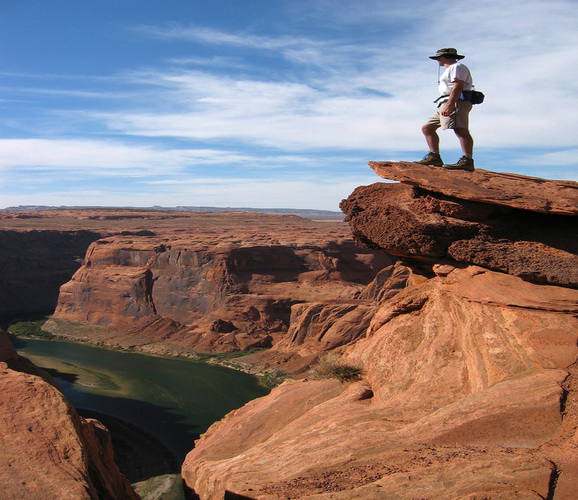
2) The concept of the "sublime" is important in philosophy in the 18th century. It had become one form of the beautiful. It marks a moment when nature literally overwhelms our senses or understanding--and perhaps fills us with a bit of awe (respect and fear). Think of a scene of the Grand Canyon:
Lots of landscape paintings at that time deal with this sense of a beautiful, yet scary nature that transcends our understanding:
At the same time, the Romantics were interested in how natural scenes opened up and spurred the human imagination--Immanuel Kant valued the sublime not for the moment when we experienced awe, but when the human mind reasserted control and understanding over its experience. Wordsworth is playing with both of these senses--how nature transcends his understanding, but also how it has spurred him to grow and understand more--even when he leaves such natural scenes.
There are other historical changes going on in England that Wordsworth is addressing, too, but I'll leave that to Wordsworth fans to discuss.
Two observations (since I don't want to re-read the whole poem right now):
1) This poem (based on its form) is clearly a reflection. The poem is unrhymed iambic pentameter (blank verse)--it's not organized into stanzas, but lines piled on one another. Blank verse is often used for speeches or reflections--unrhymed lines accommodate free-flowing thought--and here, the speaker is reflecting on a natural scene that he is returning to again.
2) The concept of the "sublime" is important in philosophy in the 18th century. It had become one form of the beautiful. It marks a moment when nature literally overwhelms our senses or understanding--and perhaps fills us with a bit of awe (respect and fear). Think of a scene of the Grand Canyon:
Lots of landscape paintings at that time deal with this sense of a beautiful, yet scary nature that transcends our understanding:
At the same time, the Romantics were interested in how natural scenes opened up and spurred the human imagination--Immanuel Kant valued the sublime not for the moment when we experienced awe, but when the human mind reasserted control and understanding over its experience. Wordsworth is playing with both of these senses--how nature transcends his understanding, but also how it has spurred him to grow and understand more--even when he leaves such natural scenes.

There are other historical changes going on in England that Wordsworth is addressing, too, but I'll leave that to Wordsworth fans to discuss.
-
jim
- Red Lobster for the seafood lover in you
- Posts: 50393
- Joined: May 1 06, 2:41 pm
Re: Poetry
I'm very interested. My kid is going to turn this in and get an A. Thanks!Smith Corks One wrote:Wordsworth is one of my favorite poets, and I love "Lines Composed a Few Miles Above Tintern Abbey". Here's an excerpt from a paper I wrote about it (partly) for a college course, if you're interested.
The process of maturing from youth to adult, and the characteristics of people in these two stages of development, are common themes explored throughout literature. While all humans who live to physical adulthood undergo some manner of maturation, these events are never identical from person to person and often vary significantly. Two very eloquent autobiographical works – the poem “Lines Composed a Few Miles above Tintern Abbey,” by William Wordsworth, and Frederick Douglass’ Narrative of the Life of Frederick Douglass – provide examples of personal maturation that, while similar in some ways, differ markedly in terms of timing, form, and circumstance.
In “Tintern Abbey,” Wordsworth describes returning to the same place that he had visited five years before. While many of his initial observations of the setting bring back vivid memories of the natural wonders he previously beheld, it soon becomes apparent that he has matured greatly in the years since his last visit. Wordsworth uses the word “again” four times in the first fourteen lines of the poem, indicating that, on the surface, his current experience mimics the previous one. Once again he “hears,” “beholds,” “reposes,” and “sees,” and for someone interested purely in the sensory perception and enjoyment of the natural world, these endeavors might be enough. For Wordsworth, however, these sensations in and of themselves fall short of the rapture that, as a more mature man, he desires – or, perhaps, requires.
Then again, maybe “requires” isn’t exactly the right word either, as the superior sense of wellness and transcendent joy that permeates his soul seems to be a direct result of his natural maturing, and as such, a state that he now carries with him always. As he writes regarding his sister, in whom he sees the excitement of his former self, “these wild ecstasies shall be matured into a sober pleasure… thy mind shall be a mansion for all lovely forms” (lines 138-40). While we often use the word “sober” as a synonym for “somber,” in the first line quoted above, Wordsworth seems to be indicating that the source of his pleasure is no longer outside influences. The following line suggests that all such pleasures can be achieved within one’s own mind.
Another word that Wordsworth uses more than once in “Tintern Abbey” is “sublime”; he describes in lines 95-102 “a sense sublime/Of something far more deeply interfused” that “rolls through all things.” While his earlier sojourns with nature are described as “course” and related as animalistic adventures, his soul now communes with the very essence that permeates the universe. This transformation seems not to have occurred through any great effort on Wordsworth’s part, but more as a natural result of the maturation process – though, perhaps, not a ubiquitous human experience, but one reserved for those sensitive and attuned enough to be considered great poets.
-
lukethedrifter
- darjeeling sipping elite
- Posts: 37260
- Joined: October 17 06, 11:19 am
- Location: Huis Clos
Re: Poetry
In HS I wrote a paper comparing Wordsworth's London 1802
Milton! thou shouldst be living at this hour:
England hath need of thee: she is a fen
Of stagnant waters: altar, sword, and pen,
Fireside, the heroic wealth of hall and bower,
Have forfeited their ancient English dower
Of inward happiness. We are selfish men;
Oh! raise us up, return to us again;
And give us manners, virtue, freedom, power.
Thy soul was like a star, and dwelt apart:
Thou hadst a voice whose sound was like the sea:
Pure as the naked heavens, majestic, free,
So didst thou travel on life's common way,
In cheerful godliness; and yet thy heart
The lowliest duties on herself did lay
with The Clash's London Calling
London calling to the faraway towns
Now war is declared, and battle come down
London calling to the underworld
Come out of the cupboard, you boys and girls
London calling, now don't look to us
Phoney Beatlemania has bitten the dust
London calling, see we ain't got no swing
'Cept for the ring of that truncheon thing
[Chorus 1:]
The ice age is coming, the sun's zooming in
Meltdown expected, the wheat is growing thin
Engines stop running, but I have no fear
'Cause London is drowning, and I live by the river
London calling to the imitation zone
Forget it, brother, you can go it alone
London calling to the zombies of death
Quit holding out, and draw another breath
London calling, and I don't wanna shout
But while we were talking, I saw you nodding out
London calling, see we ain't got no high
Except for that one with the yellowy eyes
[Chorus 2: x2]
The ice age is coming, the sun's zooming in
Engines stop running, the wheat is growing thin
A nuclear error, but I have no fear
'Cause London is drowning, and I live by the river
Now get this
London calling, yes, I was there, too
An' you know what they said? Well, some of it was true!
London calling at the top of the dial
After all this, won't you give me a smile?
London calling
I never felt so much alike [fading] alike alike alike
Milton! thou shouldst be living at this hour:
England hath need of thee: she is a fen
Of stagnant waters: altar, sword, and pen,
Fireside, the heroic wealth of hall and bower,
Have forfeited their ancient English dower
Of inward happiness. We are selfish men;
Oh! raise us up, return to us again;
And give us manners, virtue, freedom, power.
Thy soul was like a star, and dwelt apart:
Thou hadst a voice whose sound was like the sea:
Pure as the naked heavens, majestic, free,
So didst thou travel on life's common way,
In cheerful godliness; and yet thy heart
The lowliest duties on herself did lay
with The Clash's London Calling
London calling to the faraway towns
Now war is declared, and battle come down
London calling to the underworld
Come out of the cupboard, you boys and girls
London calling, now don't look to us
Phoney Beatlemania has bitten the dust
London calling, see we ain't got no swing
'Cept for the ring of that truncheon thing
[Chorus 1:]
The ice age is coming, the sun's zooming in
Meltdown expected, the wheat is growing thin
Engines stop running, but I have no fear
'Cause London is drowning, and I live by the river
London calling to the imitation zone
Forget it, brother, you can go it alone
London calling to the zombies of death
Quit holding out, and draw another breath
London calling, and I don't wanna shout
But while we were talking, I saw you nodding out
London calling, see we ain't got no high
Except for that one with the yellowy eyes
[Chorus 2: x2]
The ice age is coming, the sun's zooming in
Engines stop running, the wheat is growing thin
A nuclear error, but I have no fear
'Cause London is drowning, and I live by the river
Now get this
London calling, yes, I was there, too
An' you know what they said? Well, some of it was true!
London calling at the top of the dial
After all this, won't you give me a smile?
London calling
I never felt so much alike [fading] alike alike alike
-
Fat_Bulldog

- likes to grate his own cheese
- Posts: 12861
- Joined: May 9 06, 12:41 pm
- Location: Drunk
Re: Poetry
[expletive] poetry.
-
lukethedrifter
- darjeeling sipping elite
- Posts: 37260
- Joined: October 17 06, 11:19 am
- Location: Huis Clos
Re: Poetry
I bet you'd [expletive] then eat it if it was covered with gravy.Fat_Bulldog wrote:[expletive] poetry.
-
Fat_Bulldog
- likes to grate his own cheese
- Posts: 12861
- Joined: May 9 06, 12:41 pm
- Location: Drunk
Re: Poetry
Yes. I would.lukethedrifter wrote:I bet you'd [expletive] then eat it if it was covered with gravy.Fat_Bulldog wrote:[expletive] poetry.
-
wart57
- just can't quit you.
- Posts: 25075
- Joined: April 18 06, 4:33 pm
- Location: Lost
Re: Poetry
Fatbulldog loves gravyFat_Bulldog wrote:Yes. I would.lukethedrifter wrote:I bet you'd [expletive] then eat it if it was covered with gravy.Fat_Bulldog wrote:[expletive] poetry.
Bacon is right up there too
[expletive] it lets eat NOW!