Thanks for taking the time to answer our questions.
1. Based on the work you have done, could you rank the top five hitters of all time? How about top five pitchers?
2. I know when the SABR revolution first began, very few of the researchers, writers and thinkers were a part of the baseball establishment. Because of that most all of the cutting edge work was published and available to the masses. That leads me to this question: How much of your research, if any, are you unable to publish because it falls under the domain of your work with the Cardinals?
Questions & Answers with Mitchel Lichtman
-
onlyfacts
- All-Star
- Posts: 1267
- Joined: April 18 06, 9:45 pm
Where do you stand on the latest theories of pitchers not having as much control over batted balls as they were always assumed to have before?
Specifically the idea of giving pitchers control over all the HRs they yield seems wrong to me; after all I've seen Vlad hit one off the ground that certainly can't be placed under the pithcer's control but rather belogs to Vlad.
Specifically the idea of giving pitchers control over all the HRs they yield seems wrong to me; after all I've seen Vlad hit one off the ground that certainly can't be placed under the pithcer's control but rather belogs to Vlad.
-
ghostrunner

- GOAT
- Posts: 30639
- Joined: April 18 06, 9:40 pm
Hi Mitchel,
I remember seeing your posts on Baseball Think Factory about the Spivey signing, and you considered it a steal at the time. I had similar feelings, but of course we know what's happened since then.
To the extent you're allowed to comment, what do you think is the cause of Spivey's apparent decline? Is it a physical/health issue, did he play above his head for a while, or is the jury still out?
Thanks.
I remember seeing your posts on Baseball Think Factory about the Spivey signing, and you considered it a steal at the time. I had similar feelings, but of course we know what's happened since then.
To the extent you're allowed to comment, what do you think is the cause of Spivey's apparent decline? Is it a physical/health issue, did he play above his head for a while, or is the jury still out?
Thanks.
-
tangotiger
- Fringe Major League Player
- Posts: 101
- Joined: April 20 06, 8:33 am
- Contact:
Two of Mitchel's most important contributions are on fielding (UZR) and pitching (DIPS Revisited). You can read those articles here:
MGL at Baseball Primer
MGL at Baseball Primer
-
thrill

- bronoun enthusiast
- Posts: 30535
- Joined: April 14 06, 10:45 pm
- Location: barely online
Thanks for stopping by and bringing your expertise to this site!
My question is two-fold:
How directly do you work with the Cardinals front office/scouting with evaluating players, and how much stock does the Cardinals front office place in SABR analysis when evaluating free agent and trade options?
My question is two-fold:
How directly do you work with the Cardinals front office/scouting with evaluating players, and how much stock does the Cardinals front office place in SABR analysis when evaluating free agent and trade options?
-
mgl
- AA Minor League Player
- Posts: 35
- Joined: May 10 06, 7:44 pm
chat
Great questions so far! Keep 'em coming. I am not sure when Michael wants me to respond - after all the questions are in or in "real time." I'll check with him. I am looking forward to "chatting," as these are some of the best questions I have encountered on a fan site.
Keep in mind that although MLE's (major league equivalencies from raw minor league stats) are an important part of evaluating and projecting young talent (and even players who have been in the majors for several years, especially if they have had limited playing time), I do not follow our or any other minor league players extensively (other than computing MLE's and incorporating them into my projection and evaluation algorithms).
We do have several people in the (Cards) organization who are fantastic with minor league player evaluation and player development (as well as amateur scouting). As well, the organization is in constant flux in terms of improving that aspect. As most of you know, the draft and player development is a critical area for small and mid-market teams (it is important for large market tems as well; it is just not as evident with them).
Thanks Tom (Tango) for the reference (UZR and DIPS).
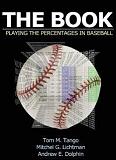
BTW, if any of you (who are interested in saber topics) have not done so, check out Tango's web site and anything you can find written by Andy Dolphin. They are my co-authors. They are two of the best and most well-rounded baseball analysts on the planet.
Of course there are several other good analysts who write articles and publish research here and there on the web, often on their own websites. Some of the good ones, off the top of my head (I apologize if I forget anyone), who are not on mainstream sites, like BTF (Primer), THT, BP, and the Baseball Analysts, are Tom Tippet, Voros McCracken, Jay Jaffe, John Jarvis, and Phil Birnbaum.
Anyway, I'll be back!
Keep in mind that although MLE's (major league equivalencies from raw minor league stats) are an important part of evaluating and projecting young talent (and even players who have been in the majors for several years, especially if they have had limited playing time), I do not follow our or any other minor league players extensively (other than computing MLE's and incorporating them into my projection and evaluation algorithms).
We do have several people in the (Cards) organization who are fantastic with minor league player evaluation and player development (as well as amateur scouting). As well, the organization is in constant flux in terms of improving that aspect. As most of you know, the draft and player development is a critical area for small and mid-market teams (it is important for large market tems as well; it is just not as evident with them).
Thanks Tom (Tango) for the reference (UZR and DIPS).
BTW, if any of you (who are interested in saber topics) have not done so, check out Tango's web site and anything you can find written by Andy Dolphin. They are my co-authors. They are two of the best and most well-rounded baseball analysts on the planet.
Of course there are several other good analysts who write articles and publish research here and there on the web, often on their own websites. Some of the good ones, off the top of my head (I apologize if I forget anyone), who are not on mainstream sites, like BTF (Primer), THT, BP, and the Baseball Analysts, are Tom Tippet, Voros McCracken, Jay Jaffe, John Jarvis, and Phil Birnbaum.
Anyway, I'll be back!
-
Reverend Redbird

- Fringe Major League Player
- Posts: 104
- Joined: May 7 06, 6:48 pm
- Location: In a van, down by the river
- Contact:
MGL,
Thanks for answering our questions and all your work you do!
I'm curious on your thoughts on the 2006 Cardinals.
One concern I have is about the pitching staff. They are the best at inducing ground-balls, but one of the worst when it comes to getting the strikeout. Does power pitching really win in the playoffs, or is that just a myth? How does this lack of having a dominant ace (outside of Carpenter, of course) bode for the Cardinals?
I've noticed just from the naked eye it seems that Hector Luna has amazing range at second base. What are your thoughts on Luna?
Is it too soon to begin to assess if the new Busch is a hitter's park, or a pitcher's park?
Thanks for answering our questions and all your work you do!
I'm curious on your thoughts on the 2006 Cardinals.
One concern I have is about the pitching staff. They are the best at inducing ground-balls, but one of the worst when it comes to getting the strikeout. Does power pitching really win in the playoffs, or is that just a myth? How does this lack of having a dominant ace (outside of Carpenter, of course) bode for the Cardinals?
I've noticed just from the naked eye it seems that Hector Luna has amazing range at second base. What are your thoughts on Luna?
Is it too soon to begin to assess if the new Busch is a hitter's park, or a pitcher's park?
-
mgl
- AA Minor League Player
- Posts: 35
- Joined: May 10 06, 7:44 pm
I am going to try and answer as many questions as I can. Please don't be offended if I don't answer yours. If I don't, it is likely that I have already answered it or something similar in response to someone else's question or comments.
Again, great questions so far. I am impressed with the quality of the site (this is my first time here).
There are no "right" answers or "best" stats for quantifying past peformance. As I said, it depends on what questions you are trying to answer and what your personal preference is (believe it or not).
However....
There are 2 basic ways to quantify value/performance. One is via an MVP-type stat which attempts to evaluate performance in the past in some nebulous way, presumably in terms of how much value a player provided to his team's "something or other." What stat or type of stat to use is really personal preference. If you only care about actual wins and losses, you are well-served to use RBI and Runs scored in games where a player's team actually won (what good are RBI and Runs when your team loses, if you only care anout ACTUAL value?). If you are going to be a little more theoretical and hypothetical in terms of your attempt to quantify value, you can use RBI and Runs scored in ALL games, whether the player's team won or lost the game. If you want to be even more "theoretical," you can use some kind of "value added" stat, whereby you calculate for each PA how much a player added to or subtracted from his team's chance of winning the game (using win expectancy tables like the ones in our book). If you want your MVP-type stat to only capture a player's skill (actually a sample of that player's skill) you can use OPS, linear weights, or something like that.
For the record, I personally think it is silly to use a "skill based" stat like OPS or lwts when you are talking about a player's past contribution to his team, such as in an MVP-type analysis. However, there are a multitude of stats and approaches that one can use in this context and some or all of them can reasonably considered "correct" IMO.
Anyway, the second way to evaluate a player is in the context of estimating his "true" skill level, comparing him to other players in a context neutral sense (e.g., who would I rather have on some hypothetical team or on MY team?), or projecting future performance. For that, there really is only one "correct" stat. That is the one that accurately captures a player's exact theoretical contribution to his team's chances of winning each game as compared to some baseline (an average player, a replacement player, etc.) This is commonly referred to as marginal run value or marginal win value. The best way to compute that is through a linear weights formula which assigns a run value to each possible outcome of a PA (offensive event). You can read more about linear weights in the Hidden Game of Baseball or in other publications and on the web.
Keep in mind that while we usually use static run values for each of the offensive events, the exact values for a particular player would vary depending upon three things: One, the league context, two, the slot in the batting order the player occupies or will occupy, and three, the lwts value (their offensive "profile") of the other players in the batting order.
However, if we assume a player plays on an average team in an average league and we don't know what his slot in the batting order is or will be, we can safely use "generic" and static lwts values. Even we used "custom values" as explained above, a player's total lwts is not going to change much.
Of what use is lwts? That is a loaded question as well. In short it gives us a snapshot or a sample of a player's "skill" and thus is the best thing to use to project future performance in any context or in a neutral context. In fact, once we have lots of data on a player (say 5 years although there is no magical number), we are pretty sure that his actual or sample lwts accurately captures his true skill (at least his average true skill as it existed in the past) and we can accurately estimate his true (theoretical) value to his team as well as his future performance (a projection).
A nice variation on the traditional lwts formula is wOBA, which is essentially a lwts rate that is artificially made to look like OBA. It is explained in our book. I love using that stat for various reasons.
The next best way to capture "skill." context-neutral theoretical performance, or value in a player's stats is a variation of OPS, which is 2OPS or 1.8OPS. OPS is of course OBA (or OBP) plus SA and 2OPS and 1.8OPS is 2*OBA plus SA and 1.8*OBA plus SA, respectively. 2OPS and 1.8OPS yield better results than OPS. This is for individual batters, BTW, although it can be used for teams and pitchers (OTS is a little better).
Although I hate OPS, also for various reasons, it is a fairly decent quick and dirty estimate of lwts or wOBA. Most of you are familiar with it. I suppose if you don't want to (or can't) compute lwts or wOBA, it is OK, but if you want to do some rigorous work or compare one player to another (and they are close in talent), using OPS, you are going to make a lot of mistakes. Another stat similar to lwts or wOBA is BaseRuns, which is actually better than lwts for pitchers and for teams, because it captures the interactive effect of one event on another (for example, if a pitcher or team allows lots of walks, the lwts value of their HR's is going to be higher), which is necessary for pitcher and teams, but not for individual batters.
O.K., that is the last question I will give such a detailed (and confusing) answer to!
Major league teams also occupy the entire gamut of being saber-knowledgeable (or not). Some teams, like OAK and BOS, and to some extent, STL (among others, such as SD and CLE), use advanced (and correct - advanced does not necessarily equate to correct) techniques to evaluate players and manage their business. Some teams, like KC (and others of course), appear to have no clue as to how to evaluate players (and manage their business). When I say "evaluate" I am not talking about "scouting." I don't know which teams are better than others at scouting and I am not sure that anyone does (or even that that question is clear and specific enoght to have a clear and specific answer).
There are two aspects to evaluating players: One, is coming up with an accurate (as accurate as you can) projection on a player's future offense performance (s,d,t,hr,bb, and so rates) and defensive performance (range and error rate). That involves statistical projection algorithms and scouting (by "scouting" I mean anything but statistical algorithms). The younger and less experienced the player, the less scouting and the more stats. Vice versa for established major leaguers. For older players, some scouting can be useful of course.
The second aspect (and the critical one) is taking a projection, be it via statistical methods, scouting, or both, and turning that into a "marginal win value" for the team. This is essential in order to properly evaluate players in terms of trades, salaries, etc. What good is knowing that A-Rod is better than Mike Lowell if you don't know how many more theoretical wins A-Rod provides to your team, and therefore how much more you would be willing to pay for him (or whether you want to play him at all or simply field some replacement player)? Even if a team had scouting geniuses that were able to nail future player peformance better than G-d himself, if they did not know how to translate those projections into marginal run or win value, those projections would be next to worthless (or at least worth a whole lot less than otherwise).
The "situation" as you say, will natrually improve itself slowly over time for two reasons. One, the competition among teams. As more and more teams "go saber" it will force other teams to do so, or they won't be able to compete, both in an economic and playing field success sense. Two, as saber-friendly information becomes more available and more commonplace (especially via the internet) and accepted, and more and more amateur and professional sabermetricians come out of the woodwork so to speak, teams (and to some extent, fans and the media) can't help but join the party.
Whew! I am exhausted.[/quote]
Again, great questions so far. I am impressed with the quality of the site (this is my first time here).
This is actually a loaded question. There are so many ways to quantify and/or express value and performance depending on what question you are trying to answer, what aspect of a player's performance you are trying to capture or reflect, etc. Are you trying to reflect a player's skill only? Do you not care whether a player's value is (presumably) a function of luck plus skill or even luck only? Do you care about a player's performance in a context neutral sense? Do you only care about a player's performance in terms of whether or not and how much he contributed to his teams actual wins (and losses)? Do you care about how how a player's performance contribued to his team's runs scored and runs allowed regardless of wins and losses? Do you care about how a player theoretically increased or decreased his team's chances of winning each game, regardless of whether they actually won the game or not and regardless of how many runs they scored or allowed?Grammar_Police wrote:Hi. Thanks for taking our questions. Here are a couple:
1. What stats do you use for a quick look at a player's performance? That is, if you wanted a fast, accurate, but not necessarily precise, picture of how a player is performing, what stats would you look to?
There are no "right" answers or "best" stats for quantifying past peformance. As I said, it depends on what questions you are trying to answer and what your personal preference is (believe it or not).
However....
There are 2 basic ways to quantify value/performance. One is via an MVP-type stat which attempts to evaluate performance in the past in some nebulous way, presumably in terms of how much value a player provided to his team's "something or other." What stat or type of stat to use is really personal preference. If you only care about actual wins and losses, you are well-served to use RBI and Runs scored in games where a player's team actually won (what good are RBI and Runs when your team loses, if you only care anout ACTUAL value?). If you are going to be a little more theoretical and hypothetical in terms of your attempt to quantify value, you can use RBI and Runs scored in ALL games, whether the player's team won or lost the game. If you want to be even more "theoretical," you can use some kind of "value added" stat, whereby you calculate for each PA how much a player added to or subtracted from his team's chance of winning the game (using win expectancy tables like the ones in our book). If you want your MVP-type stat to only capture a player's skill (actually a sample of that player's skill) you can use OPS, linear weights, or something like that.
For the record, I personally think it is silly to use a "skill based" stat like OPS or lwts when you are talking about a player's past contribution to his team, such as in an MVP-type analysis. However, there are a multitude of stats and approaches that one can use in this context and some or all of them can reasonably considered "correct" IMO.
Anyway, the second way to evaluate a player is in the context of estimating his "true" skill level, comparing him to other players in a context neutral sense (e.g., who would I rather have on some hypothetical team or on MY team?), or projecting future performance. For that, there really is only one "correct" stat. That is the one that accurately captures a player's exact theoretical contribution to his team's chances of winning each game as compared to some baseline (an average player, a replacement player, etc.) This is commonly referred to as marginal run value or marginal win value. The best way to compute that is through a linear weights formula which assigns a run value to each possible outcome of a PA (offensive event). You can read more about linear weights in the Hidden Game of Baseball or in other publications and on the web.
Keep in mind that while we usually use static run values for each of the offensive events, the exact values for a particular player would vary depending upon three things: One, the league context, two, the slot in the batting order the player occupies or will occupy, and three, the lwts value (their offensive "profile") of the other players in the batting order.
However, if we assume a player plays on an average team in an average league and we don't know what his slot in the batting order is or will be, we can safely use "generic" and static lwts values. Even we used "custom values" as explained above, a player's total lwts is not going to change much.
Of what use is lwts? That is a loaded question as well. In short it gives us a snapshot or a sample of a player's "skill" and thus is the best thing to use to project future performance in any context or in a neutral context. In fact, once we have lots of data on a player (say 5 years although there is no magical number), we are pretty sure that his actual or sample lwts accurately captures his true skill (at least his average true skill as it existed in the past) and we can accurately estimate his true (theoretical) value to his team as well as his future performance (a projection).
A nice variation on the traditional lwts formula is wOBA, which is essentially a lwts rate that is artificially made to look like OBA. It is explained in our book. I love using that stat for various reasons.
The next best way to capture "skill." context-neutral theoretical performance, or value in a player's stats is a variation of OPS, which is 2OPS or 1.8OPS. OPS is of course OBA (or OBP) plus SA and 2OPS and 1.8OPS is 2*OBA plus SA and 1.8*OBA plus SA, respectively. 2OPS and 1.8OPS yield better results than OPS. This is for individual batters, BTW, although it can be used for teams and pitchers (OTS is a little better).
Although I hate OPS, also for various reasons, it is a fairly decent quick and dirty estimate of lwts or wOBA. Most of you are familiar with it. I suppose if you don't want to (or can't) compute lwts or wOBA, it is OK, but if you want to do some rigorous work or compare one player to another (and they are close in talent), using OPS, you are going to make a lot of mistakes. Another stat similar to lwts or wOBA is BaseRuns, which is actually better than lwts for pitchers and for teams, because it captures the interactive effect of one event on another (for example, if a pitcher or team allows lots of walks, the lwts value of their HR's is going to be higher), which is necessary for pitcher and teams, but not for individual batters.
O.K., that is the last question I will give such a detailed (and confusing) answer to!
Many people can and have answered this type of question better than I. Is it frustrating to me? A little, but not too much. While working for the Cards, I came to accept the limitations within the organization in terms of understanding (or desiring to understand) and embracing the type of work I do and the concepts I work with, at least at this point in time. Understanding and using sabermetrics (let's just say in terms of evaluating players for salary, contract, and personnel decision in general, and in-game strategies) on a managment level within a baseball organization is a critical part of a team's short and long-term chance of success, both on the field and in the "bottom line," however it is only one part and can be easily masked for various reasons.2. Throughout baseball history, there are many examples of baseball writers, fans, general managers, etc using advanced statistical techniques and placing emphasis on less-heralded statistics to evaluate past player accomplishments and predict future performance. There are a myriad of people thinking about and writing about and using professionally these kinds of techniques today. However, these methods are still not incorporated into mainstream baseball. For example, it's only been in the last 4 or 5 years or so that something as simple and intuitive as OBP has been flashed on the televesion screen when a player comes to bat and it is rare to read in a newspaper about a player's OPS or WHIP. Analysts, writers and fans still use statistics such as RBIs or Wins to compare hitters or pitchers. Do you find the pace that the public and those professionally associated with baseball accept and embrace these methods frustrating and what do you think could be done to improve that situation?
Major league teams also occupy the entire gamut of being saber-knowledgeable (or not). Some teams, like OAK and BOS, and to some extent, STL (among others, such as SD and CLE), use advanced (and correct - advanced does not necessarily equate to correct) techniques to evaluate players and manage their business. Some teams, like KC (and others of course), appear to have no clue as to how to evaluate players (and manage their business). When I say "evaluate" I am not talking about "scouting." I don't know which teams are better than others at scouting and I am not sure that anyone does (or even that that question is clear and specific enoght to have a clear and specific answer).
There are two aspects to evaluating players: One, is coming up with an accurate (as accurate as you can) projection on a player's future offense performance (s,d,t,hr,bb, and so rates) and defensive performance (range and error rate). That involves statistical projection algorithms and scouting (by "scouting" I mean anything but statistical algorithms). The younger and less experienced the player, the less scouting and the more stats. Vice versa for established major leaguers. For older players, some scouting can be useful of course.
The second aspect (and the critical one) is taking a projection, be it via statistical methods, scouting, or both, and turning that into a "marginal win value" for the team. This is essential in order to properly evaluate players in terms of trades, salaries, etc. What good is knowing that A-Rod is better than Mike Lowell if you don't know how many more theoretical wins A-Rod provides to your team, and therefore how much more you would be willing to pay for him (or whether you want to play him at all or simply field some replacement player)? Even if a team had scouting geniuses that were able to nail future player peformance better than G-d himself, if they did not know how to translate those projections into marginal run or win value, those projections would be next to worthless (or at least worth a whole lot less than otherwise).
The "situation" as you say, will natrually improve itself slowly over time for two reasons. One, the competition among teams. As more and more teams "go saber" it will force other teams to do so, or they won't be able to compete, both in an economic and playing field success sense. Two, as saber-friendly information becomes more available and more commonplace (especially via the internet) and accepted, and more and more amateur and professional sabermetricians come out of the woodwork so to speak, teams (and to some extent, fans and the media) can't help but join the party.
Whew! I am exhausted.[/quote]
-
mgl
- AA Minor League Player
- Posts: 35
- Joined: May 10 06, 7:44 pm
Things generally change in the direction of more complex technology, although not necessarily for the better (society evolves through greed and power/ego).Popeye_Card wrote:I didn't see any exerpts to the side about defense.
1.) Do you think we will ever see the day when there are great defensive statistics? For an aspect of the game that is so important, it remains so subjective.
2.) Staying on the defense topic, did you consider adding a chapter to "The Book" about defensive alignments and their success/failure rate?
Thanks,
--P--
Evaluating defense is not subjective. Not any more subjective than offense. It is just more difficult (but not nearly impossible) to evaluate objectively (and accurately).
We are in the dark ages in terms of defense as it is understood and expressed by the media and the fans. We are in the industrial age, however, but not quite in the computer age, as far as evaluating defense is concerned within some teams and withing the sabermetric community. Methods like UZR and the "plus-minus system" in Dewan's "The Fielding Bible" (among others) are almost equivalent to OPS in terms of evaluating offense. That's not bad. Not bad at all!
Some things evolve slowly (everything evolves) for several reasons. In baseball, one, because there is not yet that much pressure to change and, two, it is run by "old school Neanderthals" (managers, coaches, etc.) and rich, but not necessarily very smart, businessmen, who once dreamt of being professional ballplayers (owners). The GM's are generally somewhere in between. Actually some of them are miles ahead of the owners, although there are a few owners who are obviously rich AND smart.
Someday soon, we will see ZR (STATS zone rating) being talked about by the manistream media and fans. Eventually, we will see more advanced metrics come to the forefront. How long? Maybe 5 years for the former and 10 or 15 years for the latter?
There are many things we wanted to put in the book, but simply didn't have the time or the room (who wants to read a 600 page book without pictures?). Defensive alignment (I assume you mean whether a shift is optimal for certain players, whether it is optimal to guard the lines late in a close game, etc.) is something we could have addressed I suppose, although it didn't come up in our planning for the book, I don't think.
Discussing various defensive evlaution systems, as in The Fielding Bible, was probably not appropriate for this type of book, and thankfully, John Dewan came out with a great (seminal) book on that topic.
Tom, Andy, and myself have discussed doing a second book along the same lines as the first, as there are many important and interesting topics we wanted to but did not include (and many of them are discussed in another great book, IMO, "Baseball Between The Numbers" by the Baseball Prospectus guys) in The Book.
In The Book (in both the Sac Bunt chapter and the chapter on Game Theory) we discuss the importance (from both the perspective of the offense as well as the defense) of defensive alignment, in anticipating or executing the sacrifice bunt. Our analysis is fascinating, if I may say so myself.